The Justification Gap
Why UK and Ireland buying journeys stall, and what brings them back
2026 Buyer Experience Study: UK & Ireland Edition

Most deals don’t die in the bake-off.
By the time a UK or Ireland buying group speaks to a seller, it has usually settled which vendor it prefers. 77% of the time that vendor goes on to win. What the group has not settled is whether the problem is worth money at all, and that is the argument that kills deals.
The 2026 Buyer Experience Study, run by 6sense with MarketOne and covering 993 UK and Ireland buyers, includes something new this year: 281 evaluations that never reached a decision. They ran for nearly 9 months, most had already spoken to sellers, and almost four in five expect to be back within a year.
View the 6 numbers as text
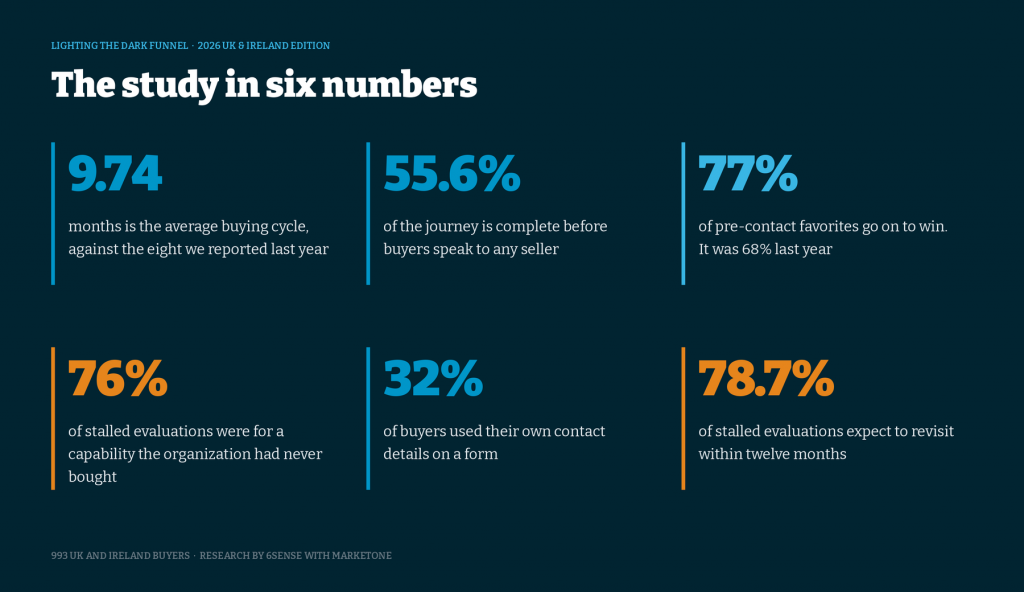
The study in six numbers. Lighting the Dark Funnel, 2026 UK and Ireland Edition.
- 9.74 months is the average buying cycle, against the eight months we reported last year on a smaller sample.
- 55.6% of the journey is complete before buyers speak to any seller.
- 77% of pre-contact favorites go on to win. It was 68% last year.
- 32% of buyers used their own contact details on a form. 43.5% sent a colleague instead.
- 76% of stalled evaluations were for a capability the organization had never bought, against 59% of completed purchases.
- 78.7% of stalled evaluations expect to revisit the decision within twelve months.
Source: 2026 Buyer Experience Study, run by 6sense with MarketOne. 993 UK and Ireland buyers.
Every buying group answers two questions. Marketing only helps with one.
- What It Settles Early:
-
- Which vendors make the shortlist, in 92.3% of journeys
- How those vendors rank, in 90.5%
- What the requirements are, in 88.9% of journeys that go on to buy
- What It Struggles To Settle:
-
- Whether the category deserves the budget: 63% of stalled journeys say this was the harder argument
- Whether anyone can show the problem is worth solving: 27.1% could not find the material
- Whether the vendors are actually different: 37.1% said none stood out
- What Happens When It Cannot:
-
- The evaluation pauses after an average of 8.47 months
- 77.9% have already spoken to sellers by then
- 61% of budget blocks were company-wide freezes, not a judgment on the purchase
View the four-state model as text
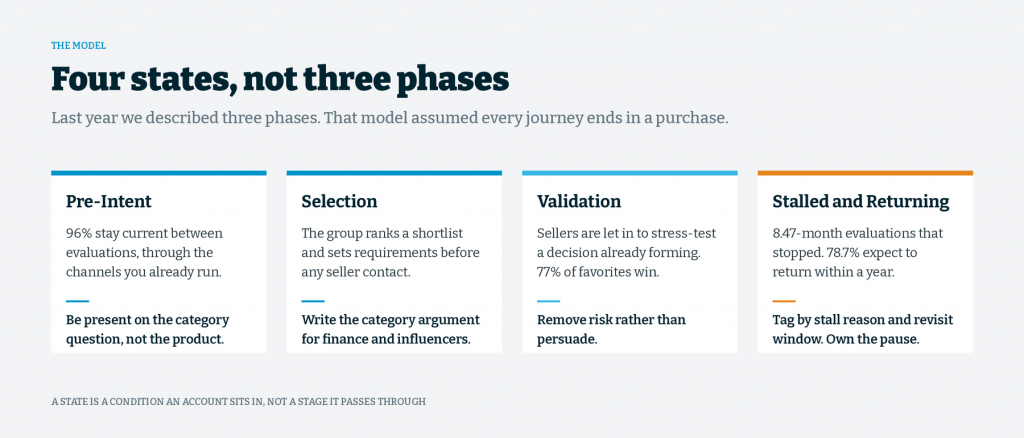
Four states, not three phases. Last year we described three phases. That model assumed every journey ends in a purchase.
A state is a condition an account sits in, not a stage it passes through. An account can hold any of these four at any time, and a stalled evaluation can return to an earlier one.
- Pre-Intent. What the group is doing: 96% stay current between evaluations, through the channels you already run. The play: be present on the category question, not the product.
- Selection. What the group is doing: the group ranks a shortlist and sets requirements before any seller contact. The play: write the category argument for finance and influencers.
- Validation. What the group is doing: sellers are let in to stress-test a decision already forming, and 77% of pre-contact favorites win. The play: remove risk rather than persuade.
- Stalled and Returning. What the group is doing: evaluations averaging 8.47 months that stopped, of which 78.7% expect to return within a year. The play: tag by stall reason and revisit window, and own the pause.
The 2026 study covers 281 UK and Ireland evaluations that did not end in a purchase, which is why there is a fourth state.
The study
- 993 UK and Ireland buyers surveyed, 911 in the UK and 82 in Ireland
- 4,611 buyers globally
- Fourth annual study by 6sense
- Three surveys: the main buyer experience survey, a parallel survey on AI and economic conditions, and a new survey of evaluations that did not reach a decision
- Purchases with an annual value of at least $25,000
- Comparison with global findings throughout
The partnership
MarketOne is lead sponsor of the UK and Ireland study and a research partner on the global study. We operate the full enterprise revenue stack as one team: the data layer, the platforms, buying-group outreach, and in-language execution across 18 languages and eight offices.
What the report covers
- What changed in UK and Ireland buying behavior this year, including a correction to a figure we published in 2025
- Why journeys that attempt something new fail more often than journeys that replace something
- Which function in the buying group separates a purchase from a stall
- How buyers actually use AI during an evaluation, and why discovery is not the exposure
- What a stalled evaluation does next, and who comes back with it
- The four-state model, with a play and a measure for each state
- A five-question diagnostic for your own program
Four in five stalled deals come back. Most teams have no plan for them.
77.9% of stalled UK and Ireland evaluations reached seller contact before they paused. 67.3% ended with a better view of the vendors they had spoken to, and 97.2% would consider the same vendors again. Nearly half will return with a different budget and almost a third with different people in the room.
Those accounts are sitting in your CRM, tagged closed-lost. The report sets out what to do with them.