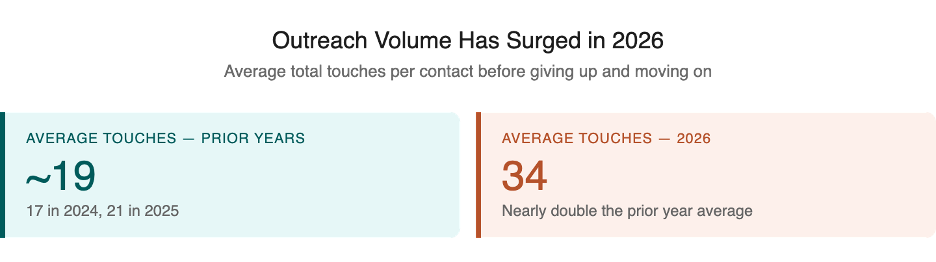
AI adoption among BDR teams hit 99% this year, up from 53% just two years ago. Outreach volumes have doubled, rising from roughly 17 touches per contact in 2024 to 34 in 2026. Over half of organizations increased BDR quotas, the highest level in five years. And average quota attainment is statistically unchanged from last year: 92% versus 89%.
That’s the central tension running through the 2026 State of the BDR report, published this week by 6sense in partnership with MarketOne. We were excited to work with 6sense on the design, scale, and interpretation of the research, now in its fifth year. 872 BDRs responded to this year’s survey, the majority working in software and technology (70%), followed by services (23%) and manufacturing (7%).
The report title captures it well: In a Brave New AI World, BDR Performance Still Comes Down to the Fundamentals.
Want to dive straight in?
Read the full report here: State of the BDR 2026
For the complete statistical analysis, explore the deep dive: State of the BDR 2026: Deep Dive
Watch our exclusive webinar with Kerry Cunningham of 6sense and MarketOne CRO, Mike Turcotte: “BDRs have everything they need, the problem is what happens next”.
The story underneath the numbers
Before walking through the findings, it is worth naming the pattern that connects them, because the individual statistics are less important than what they add up to.
Across every dimension of this report, the same gap appears. Organizations have invested in the right capabilities: signal tools, AI, multi-threading practices, expanded cadences. But those capabilities are not reaching the decisions they were bought to inform. They are shaping the edges of execution rather than the structure of the work.
The result is a paradox that will feel familiar to anyone running a revenue team. BDRs are doing more than ever. The outcomes have not moved. And the instinct in most organizations, to push harder, add more tools, or raise the bar, is precisely what the data says does not work.
Three findings make this concrete.
1. The operationalization gap
This is the finding we keep coming back to.
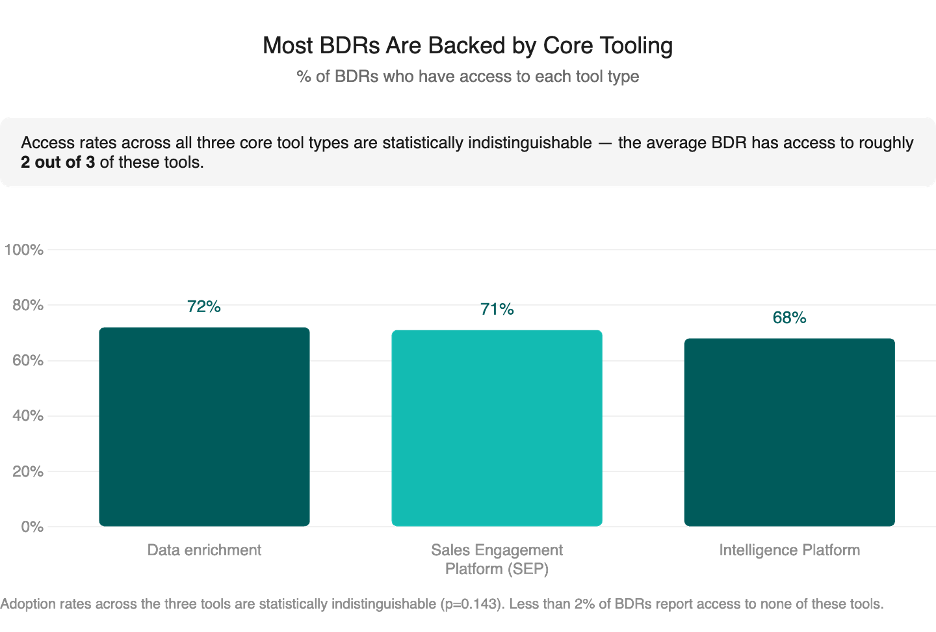
90% of BDRs say their organization uses tools designed to identify accounts likely in an active buying process. These tools exist to answer two questions: which accounts should we work, and when should we start?
In practice, they are answering neither.
Only 2% of BDRs say those systems determine which accounts they work. Only 19% say they trigger when outreach begins. What the tools mostly do is shape how BDRs engage once an account is already in play. 83% of BDRs say they adjust their outreach based on buying stage, offering personalised content, customer references, or event invitations to earlier-stage prospects, and shifting toward direct meeting requests for later-stage ones.
That is useful, but it is downstream. The two decisions that matter most, which accounts and when, are still overwhelmingly made by people through territory assignments, marketing programs, or sales leadership direction. The intelligence sits in the system. The decisions sit with humans who are not using it.
The cost shows up in a single, measurable metric. “Wrong timing” is tied as the number one reason prospects say no, at 78%. Among organizations that have the prioritisation tools and set differentiated targets for in-market accounts, that figure drops to 44%.
The intelligence exists. The gap is between having it and letting it do its job.
This is consistent with what we see in our Buyer Experience research with 6sense, where buyers report forming their shortlists before speaking with any seller, placing four out of five vendors on that list from day one, and selecting their first choice eight times out of ten. Most BDRs are reaching out to accounts that are either not yet buying or have already decided. The tools to fix that are deployed. They are just not connected to the routing.
2. More outreach is not the answer
The instinct when pipeline is under pressure is to do more. More calls, more emails, more touches. The data is clear that this instinct is wrong.
BDRs now deliver an average of 34 touches per contact, up from 21 last year and 17 the year before. AI-powered dialing tools and voice agents are partly responsible, adding roughly seven touches per cadence compared with teams not using them. Individual contacts receive outreach nearly every working day, sustained for anywhere from six weeks to nearly three months depending on the offering and motion.
Multi-threading is near-universal at 91%. Outreach commonly spans 9 to 15 individual contacts per account. Each of those contacts receives their own cadence at roughly the same intensity.
The scale of this is worth pausing on. A single account can receive hundreds of outreach attempts across a dozen stakeholders over several months. From the prospect’s side, that is a significant volume of contact from a single vendor.
And yet sheer outreach volume is not a reliable predictor of performance. The regression is unambiguous (p=.510). What does predict performance is the number of distinct contacts reached per account, training hours, time spent actually talking to prospects rather than on administrative work, and the number of tools BDRs have access to.
The lever is not intensity. It is coverage, quality, and conditions.
This is a finding that should challenge any organization whose response to a pipeline shortfall is to increase cadence length or add more touches. The industry has already run that experiment. Cadences have doubled in two years. The needle has not moved.
3. Support outperforms pressure
Over half of BDR organizations increased quotas in 2026, the highest level in five years. And at first glance, it appears to work: BDRs with increased quotas report higher attainment than those whose quotas stayed the same or decreased.
But the report tests this carefully. When perceived job support is factored into the regression, the effect of raising quotas disappears (p=0.222). The apparent benefit of higher quotas was not caused by the higher bar. It was explained by the fact that organizations raising quotas also tended to be the ones where BDRs felt more supported.
For the fifth consecutive year, perceived job support is the single strongest predictor of BDR performance. It explains nearly 15% of the variation in quota attainment on its own. BDRs who feel well-supported achieve roughly 100% of quota. Those who do not sit at about 77%. That gap has widened from 14 points last year to 23 points this year.
What makes this actionable rather than abstract is that the report identifies the specific organizational practices that predict higher support scores:
- Closing the feedback loop. Organizations that systematically capture why prospects say no, and visibly use that data to refine targeting and messaging, see meaningfully higher support scores. BDRs feel heard when their field experience shapes strategy.
- Aligning compensation with expected behaviour. Two-thirds of organizations reward multi-threading in compensation or performance evaluations. Those that do see BDRs reaching roughly 12 contacts per account versus 9 in organizations that do not, and report higher support scores. When what you ask for and what you reward are the same thing, reps notice.
- Equipping reps for the job as it actually exists. BDRs who rely solely on personal AI tools report lower support than those with access to company-provided alternatives. The signal is not about which tools, it is about whether the organization is keeping pace.
- Trusting BDR judgement. Greater autonomy over outreach timing and messaging is associated with higher support. Prescribing every element of the approach sends the opposite signal.
- Treating BDRs as partners, not pipeline generators. BDRs who understand the buying role of the person they are engaging, and who participate in the handoff to sales rather than simply marking a record as qualified, report meaningfully higher support. Only 36% complete the full handoff sequence: qualifying, providing notes, booking the meeting, and attending it themselves.
- Investing in development. Training hours are a reliable predictor of both support and performance. About three-quarters of training’s effect on performance is direct skill-building. The remaining quarter operates through the message it sends: that the organization believes in its BDRs and is committed to their growth.
None of these are surprising. The data simply confirms, for the fifth year running, that the organizations actually doing them are the ones seeing results. Most organizations are responding to a tough market by tightening the screws. The data says the lever is somewhere else.
The AI paradox
One finding deserves its own section because it cuts across the other three.
AI adoption among BDRs has moved from 53% in 2024 to 99% in 2026. Most BDRs are not waiting for their organizations to act: only 27% use company-provided tools exclusively, while 35% rely on personal tools like ChatGPT or Claude, and 36% use both.
But which applications BDRs use matters more than whether they use AI at all.
The most widely adopted use, producing messages and content (74% of AI users), shows no reliable association with higher quota attainment. Neither does automated outreach (37%).
The application that is reliably associated with better performance is reviewing and analysing conversations, including role-play and call simulation, used by 62% of AI-adopting BDRs. Account identification and prioritisation (35%) also shows a directional advantage.
The pattern is striking. The AI uses focused on doing more of what BDRs were already doing, drafting faster and sending more messages, are not moving the number. The AI uses focused on doing things differently, improving conversation quality and sharpening who gets worked, are the ones associated with performance gains.
This mirrors the broader pattern across the report. The problem is not execution capacity. BDRs have more capacity than ever. The problem is what that capacity is pointed at.
The structural shifts
Two additional findings are worth noting for leaders thinking about the shape of their BDR function.
Reporting is swinging back toward Marketing. After peaking at 80% reporting into Sales in 2025, the split has returned to roughly 63/37, nearly back to the 60/40 observed in 2022. At the same time, inbound work rose from 15% to 30% of BDR activity, and the share of prospects passed as fully qualified opportunities dropped from 73% to 61%. These shifts suggest organizations are reconsidering how much qualification should happen before sales gets involved, and where in the buying journey BDRs contribute the most.
The role is not in decline. Headcount reductions dropped to 8%, the lowest in five years. About 58% of organizations report growing their BDR teams. BDRs themselves remain largely optimistic about career progression, with 53% aiming for a sales role. AI has not eliminated the function. It has changed what the function needs to be good at.
What this means in practice
The report’s conclusion is direct: the gap is not between organizations that have invested in capabilities and those that have not. Nearly everyone has invested. The gap is between organizations that have embedded those capabilities into how work actually gets assigned, prioritised, and measured, and those that have deployed them and moved on.
Having the tools is not the same as using them. Having a bigger cadence is not the same as reaching the right accounts. Having a higher quota is not the same as creating the conditions where that quota can be met.
We see this pattern at the coalface every day. When we build signal-led outbound programs with clients, the technology is only part of it. The harder, more valuable work is restructuring how accounts flow to BDRs so that signal data shapes the queue and not just the talk track. Building handover processes where BDRs participate in the sales meeting rather than handing off a name. Creating the support infrastructure, the training, the autonomy, the feedback loops, that this data says matters more than any single tool or tactic.
The findings reinforce why we approach BDR programs the way we do: grounded in signals, focused on the right accounts at the right time, and built on a foundation that treats BDRs as informed partners in the revenue process rather than interchangeable executors of volume.
Read the full report here: State of the BDR 2026
For the complete statistical analysis, explore the deep dive: State of the BDR 2026: Deep Dive
Coming June 9th: Kerry Cunningham (6sense) and Enrico Brosio (MarketOne) go live to unpack the findings and discuss what they mean in practice. Watch this space for the sign-up link.