Part 2 of our series on the 2026 State of the BDR Report, co-produced by 6sense and MarketOne International
In our first post on the 2026 State of the BDR report, we identified a pattern running through the entire dataset: organizations have invested heavily in the right capabilities, but those capabilities are not reaching the decisions they were bought to inform. Nowhere is that more visible than in how organizations use, or fail to use, account prioritization tools.
This is the finding we keep coming back to, because it touches everything else: quota attainment, outreach efficiency, prospect experience, and the ROI of every signal tool sitting in your tech stack.
Want to get straight to the facts? Read the report here.
Watch our exclusive webinar with Kerry Cunningham of 6sense and MarketOne CRO, Mike Turcotte: “BDRs have everything they need, the problem is what happens next”.
The numbers
90% of BDRs report that their organization uses tools designed to identify accounts likely in an active buying process. These are platforms that ingest web behavior, content consumption, keyword research patterns, and other digital signals to surface which accounts are showing signs of active evaluation.

These tools are designed to answer two questions. Which accounts should we work? And when should we start?
In practice, they are answering neither.
Only 2% of BDRs say those systems determine which accounts enter their queue. Only 19% say signal data triggers when outreach begins. The decisions about which accounts get worked and when are still overwhelmingly made by people: through territory assignments, marketing programs, sales leadership direction, or the BDR’s own prospecting. What the tools mostly do is influence how BDRs engage once an account is already in play. 83% say they adjust their outreach approach depending on whether a prospect appears to be early or late in their buying process. They offer personalized content, customer references, or event invitations to earlier-stage prospects, and shift toward direct meeting requests for later-stage ones.
That is useful. But it is downstream. The two decisions that matter most have already been made without the intelligence the tools were bought to provide.
Where the cost shows up
“Wrong timing” is tied with “already using a competitor” as the number one reason prospects say no. At a surface level, that looks like an unavoidable reality of outbound sales. Look deeper and the data tells a different story.
Among BDR organizations that have account prioritization tools but do not set differentiated performance targets for in-market accounts, the “wrong timing” rejection rate sits at about 65%. Among those that have the tools and do set differentiated targets, it drops to 44%.
Same technology. Different operationalization. Measurably different result.
The 61% of organizations that set differentiated targets for in-market accounts have done something beyond deploying a platform. They have made an operational and, arguably, cultural commitment to embedding signal data into how their teams actually work. The signal moves from a dashboard that BDRs can consult if they choose to an input that shapes account routing, target setting, and outreach prioritization by design.
The other 39% have the intelligence. They just haven’t connected it to the workflow.
Why the gap persists
The report gives us a useful window into how work actually reaches BDRs, and it explains a lot about why signal tools remain underutilized.
Nearly half (43%) of territory-based assignments trigger outreach immediately upon the BDR receiving the account, with no additional buying signal required. The assignment itself is the signal. When an organization’s operating model treats account ownership as the trigger for outreach, there is no structural entry point for signal data to influence what happens next.
When accounts arrive through marketing programs, the picture is slightly better. BDRs are more likely to wait for some evidence of buyer activity, either system-flagged (32%) or human-interpreted (38%), before beginning outreach. But even here, the signal data is often layered on top of decisions that have already been made, rather than shaping which accounts enter the program in the first place.
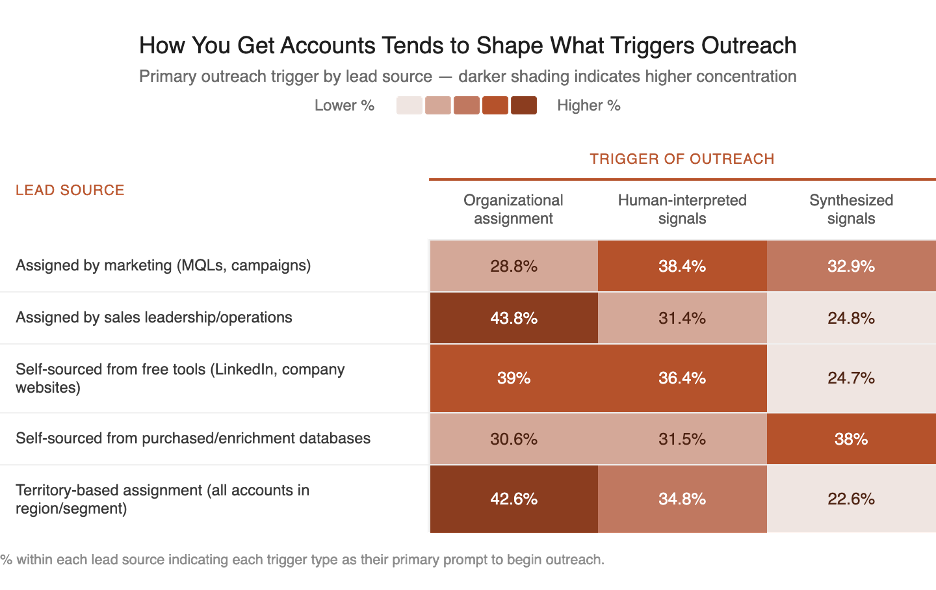
The report also shows that BDRs sourcing accounts themselves through LinkedIn or public databases often treat the act of identifying the account as sufficient reason to begin outreach (39%). In these self-directed models, the BDR is doing double duty as both prospector and qualifier, with limited structural connection to the buying signals their organization is paying to capture.
The pattern is consistent across routing models: signals sit in one system, decisions happen in another, and the distance between them is where opportunity is lost.
What this means for buyers
This is worth connecting to what we know from the buyer side. The 6sense Buyer Experience Research, based on over 4,000 B2B buyers, tells us that buyers avoid speaking with sellers until roughly 61% of their journey. They place four out of five vendors on their shortlist from day one. They rank those vendors before any sales contact. And they select their first choice eight times out of ten.
In that context, reaching out to an account that is not in an active buying process is not just inefficient for the BDR. It is unlikely to create demand that doesn’t exist. The buyer has not yet started their journey, or they started it and you were not on the list they formed before they were willing to talk.
Account prioritization tools exist precisely to solve this problem: identify the accounts where the journey is underway, focus BDR capacity on those accounts, and reduce the time spent on prospects whose answer is inevitably “not right now.” The fact that 90% of organizations have made the investment but only a fraction have completed the integration into BDR workflow is the single largest efficiency gap in B2B sales development today.
What operationalization actually looks like
This is the work we do with clients every day at MarketOne, and it is where our Signal Intelligence Framework and SD360 model were designed to operate.
When we deploy 6sense and build signal-led outbound programs, the platform configuration is only the starting point. The harder, more valuable work is redesigning how accounts flow to BDRs. That means building tiered routing logic where signal combinations determine account priority: Tier 1 accounts (active third-party intent plus first-party engagement plus visible buying group) get immediate, fully personalized outreach across the buying committee. Tier 5 accounts (ICP fit only, no observable signals) receive paid media coverage and are monitored for signal emergence, but no BDR outreach.
The tiers in between receive calibrated levels of attention. The BDR team’s capacity is allocated proportionally to signal strength, not distributed evenly across a territory list. When signal data shapes the queue rather than just the talk track, two things change. First, BDRs spend more of their time on accounts that are actually in an active evaluation. Second, the outreach they deliver is grounded in observed behavior rather than a generic value proposition, which changes the quality of the conversation from the first touch.
In one program for a global digital infrastructure provider, this approach generated 100 qualified leads from 1,850 target accounts, a 14.2% determination-to-BQL conversion rate, and an estimated $15M to $25M in sales-ready pipeline. The signal intelligence framework didn’t replace the BDR function. It told the BDR function where to point.
The uncomfortable question
If your organization has invested in account prioritization tools, it is worth asking a direct question: do those tools actually change which accounts your BDRs work, and when they start working them? Or do they sit alongside an existing territory model, consulted occasionally but structurally disconnected from the decisions that determine where BDR capacity goes?
The data is unambiguous. The tools work. But only for the organizations that let them do their job.
Read the full State of the BDR 2026 report here.
Explore the deep dive with full statistical analysis here.
Coming in June: Kerry Cunningham (6sense) and Enrico Brosio (MarketOne) go live to unpack the findings.